
Copyright on Software: Protecting Innovation in the Digital Era
Introduction
In today’s digital-first world, software is the backbone of innovation. From operating systems and mobile applications to enterprise tools and video games, software touches nearly every aspect of modern life. As with any creative work, the law provides protections for software developers and companies through intellectual property (IP) rights. Among these, copyright on software plays a vital role in safeguarding originality and preventing unauthorised exploitation.
This article explores the meaning, scope, limitations, and importance of copyright on software. It delves into the legal frameworks, landmark cases, and global perspectives that define how copyright applies to code, user interfaces, and related digital assets.
What is Copyright on Software?
Copyright is a form of intellectual property that grants creators exclusive rights over their original works of authorship. Traditionally, this applied to books, music, films, and artwork. However, as computing evolved in the late 20th century, legal systems recognised that software too is an expression of creativity, combining logic, structure, and design.
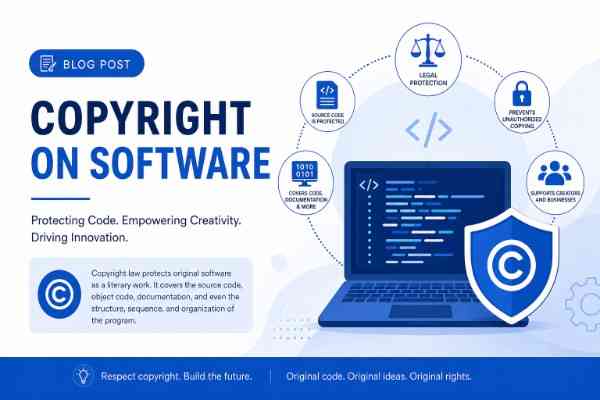
Thus, copyright on software means that the original source code, object code, and in some cases, the graphical user interface (GUI) or design, is protected as a literary work. The creator or owner has exclusive rights to:
- Reproduce the software.
- Distribute copies.
- Prepare derivative works (modifications, updates, plugins).
- Perform or display the work publicly (for software with audiovisual elements, such as video games).
This ensures that developers benefit from their intellectual labour while encouraging innovation.
Why Software Needs Copyright Protection
The importance of copyright on software lies in its ability to safeguard creative effort, time, and investment. Without protection, anyone could copy or replicate a program without credit or compensation to the creator. Some key reasons include:
- Encouraging Innovation: Protecting software ensures developers continue creating new programs.
- Preventing Unauthorised Use: Copyright helps stop piracy, unlicensed distribution, and plagiarism.
- Commercial Value: Software companies often monetise products through licensing agreements, royalties, or subscription models.
- Moral Rights: Developers are recognised as the original creators, maintaining their reputation.
Copyright on Software vs. Patents
While copyright protects expression, patents safeguard ideas and functional processes. This distinction is crucial in software law:
- Copyright: Protects how code is written, structured, and expressed.
- Patents: Protect specific algorithms, methods, or technical solutions.
For example, the source code for a word processor may be copyrighted, but a novel spell-checking algorithm could be patented. Both work together, but copyright remains the more accessible and widely applied protection.
International Recognition of Software Copyright
Globally, treaties and conventions have standardised the approach to copyright on software:
- Berne Convention – Recognises computer programs as literary works.
- TRIPS Agreement (WTO) – Mandates copyright protection for software across member nations.
- WIPO Copyright Treaty – Extends digital protection to software and databases.
This global framework ensures that software enjoys consistent rights across borders, although enforcement can vary depending on jurisdiction.
Scope of Copyright on Software
The scope of copyright protection extends to:
- Source Code: The human-readable instructions written by programmers.
- Object Code: The machine-executable version of software.
- User Interface Design: Layouts, menus, icons, and graphical designs.
- Documentation: Manuals, help files, and training materials.
However, copyright does not protect:
- Ideas, concepts, or algorithms (these fall under patents).
- Methods of operation (functional aspects).
- Facts or mathematical principles underlying the code.
This limitation balances protection with the need for open innovation.
Copyright Ownership
Ownership of software copyright depends on the circumstances of creation:
- Individual Developers – The author owns the copyright unless transferred.
- Employee-Created Software – Typically, the employer owns the rights under the “work for hire” doctrine.
- Commissioned Work – Contracts often specify ownership, making it crucial to define rights upfront.
- Collaborative Development – In joint projects, co-authors share ownership unless agreements state otherwise.
Clear agreements are essential to avoid disputes in ownership and licensing.
Duration of Copyright on Software
The duration of copyright protection varies by jurisdiction:
- United States: Author’s life plus 70 years (for individual creators). For corporate authorship (work for hire), protection lasts 95 years from publication or 120 years from creation, whichever is shorter.
- European Union: Life of the author plus 70 years.
- India: Life of the author plus 60 years.
This long protection ensures developers and companies can reap benefits well beyond initial release.
Infringement of Software Copyright
Software copyright infringement occurs when someone:
- Copies or distributes software without permission.
- Uses cracked versions or pirated copies.
- Creates derivative works without authorisation.
- Circumvents licensing agreements.
Common forms include illegal downloads, counterfeit CDs/DVDs, or unlicensed corporate use. In fact, the Business Software Alliance (BSA) has consistently reported billions in losses due to global software piracy.
Legal Consequences
- Civil Remedies: Damages, injunctions, seizure of pirated copies.
- Criminal Penalties: Heavy fines, imprisonment in cases of willful infringement.
Fair Use and Software
The concept of fair use (in the U.S.) or fair dealing (in other jurisdictions) allows limited usage of copyrighted material without permission. In the case of software:
- Permissible: Backup copies, reverse engineering for interoperability, academic use.
- Not Permissible: Sharing pirated versions, modifying software for resale, or bypassing protection.
Courts carefully assess whether use falls under fair use principles, balancing the interests of creators and the public.
Landmark Cases on Copyright on Software
Several legal cases have shaped the understanding of software copyright:
- Apple Computer, Inc. v. Franklin Computer Corp. (1983) – Established that object code is copyrightable.
- Lotus Dev. Corp. v. Borland Int’l (1996) – User interface command hierarchies were not copyrightable as they were methods of operation.
- Oracle America, Inc. v. Google, Inc. (2021) – Concerned copyright over Java APIs; the Supreme Court ruled in favour of Google, emphasising fair use.
These cases demonstrate the evolving and complex nature of copyright in the software industry.
Open Source Software and Copyright
Interestingly, even open source software relies on copyright law. Authors retain rights but allow others to use, modify, and distribute their code under specific licenses, such as:
- GNU General Public License (GPL)
- MIT License
- Apache License
These licenses ensure freedom while maintaining attribution and compliance with terms. Copyright is the foundation that makes open-source licensing enforceable.
Challenges in Software Copyright
Despite its benefits, copyright on software faces several challenges:
- Rapid Technological Change – Laws often lag behind advancements.
- Global Enforcement – Piracy across borders is difficult to regulate.
- Overlap with Other IP Laws – Determining when to apply copyright, patent, or trade secret protections.
- AI-Generated Software – Who owns the copyright when AI writes code? This is an emerging debate.
Copyright vs. Software Licensing
It’s important to distinguish between copyright ownership and software licensing:
- Copyright: The legal right of the creator or owner.
- License: A contractual agreement defining how users can use the software (e.g., single-user, enterprise, open-source).
Licensing is the mechanism by which copyright owners monetise and control usage of their work.
Future of Copyright on Software
The future presents new questions:
- Artificial Intelligence: With AI writing code, determining authorship and ownership will require updated laws.
- Cloud Software: Software as a Service (SaaS) changes how ownership and access are managed.
- Global Harmonisation: As software is used worldwide, international copyright harmonisation will become increasingly important.
Conclusion
Copyright on software remains one of the most powerful tools for protecting intellectual property in the digital age. By granting creators control over their code and related works, copyright ensures that innovation continues to thrive while providing legal remedies against unauthorised use.
From individual programmers to multinational corporations, copyright protection underpins the software economy. While challenges such as piracy, AI, and cross-border enforcement persist, the system continues to evolve to balance creativity, access, and innovation.
In essence, copyright on software is not just about protecting code—it is about encouraging innovation, fostering trust in the digital economy, and ensuring that creators receive recognition and reward for their contributions.
Need Help Protecting Your Innovation?
We provide patent, trademark and product development services. Get in touch to turn your idea into a market ready product.
Learn More