
How Does a Patent and Trademark Office Work?
Innovation and brand identity are critical pillars of modern commerce. Inventors, entrepreneurs, and companies invest significant time, resources, and creativity into developing new products, technologies, and brands. To protect these innovations and identities, legal systems around the world rely on the Patent and Trademark Office—an institution designed to grant, manage, and enforce intellectual property rights. Understanding how a Patent and Trademark Office works is essential for inventors, businesses, and legal professionals seeking to secure patents, trademarks, and other forms of intellectual property.
This article provides an in-depth exploration of the functions, processes, organisational structure, legal framework, and challenges of a Patent and Trademark Office.
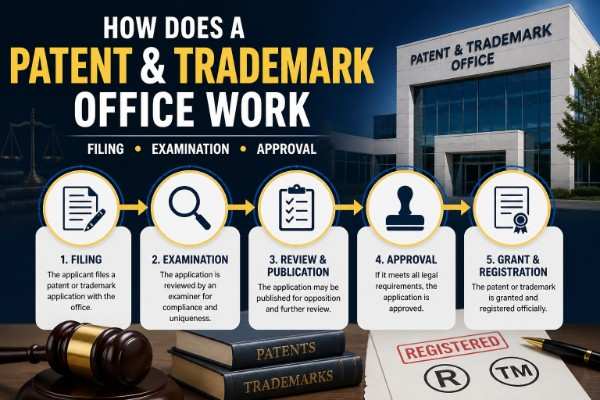
1. Introduction to the Patent and Trademark Office
A Patent and Trademark Office (PTO) is a governmental or quasi-governmental body responsible for administering intellectual property (IP) rights. Its primary objectives include:
- Granting Patents: Providing inventors exclusive rights to their inventions for a specified period, typically 20 years.
- Registering Trademarks: Protecting brand names, logos, slogans, and other identifiers used to distinguish goods and services.
- Maintaining Public Records: Ensuring transparency by maintaining databases of patents and trademarks for public access.
- Promoting Innovation and Brand Protection: Encouraging technological and commercial innovation by safeguarding intellectual property rights.
Globally, each country or region maintains its own PTO, such as the United States Patent and Trademark Office (USPTO), the European Patent Office (EPO), or the Intellectual Property India Office.
2. Organisational Structure of a Patent and Trademark Office
A Patent and Trademark Office typically has several divisions and departments to manage its complex functions:
A. Patent Division
- Examination Department: Reviews patent applications to ensure they meet legal criteria such as novelty, inventive step, and industrial applicability.
- Search Department: Conducts prior art searches to determine if the invention has been disclosed elsewhere.
- Legal/Compliance Team: Ensures patents comply with national and international laws.
B. Trademark Division
- Application Examination: Verifies that the trademark is unique, non-confusing, and not identical or similar to existing trademarks.
- Classification Department: Categorises trademarks according to international classes of goods and services (Nice Classification).
- Opposition/Dispute Resolution: Handles objections, oppositions, and cancellation requests.
C. Administrative Departments
- Public Information Services: Provides access to patent and trademark databases for research and due diligence.
- Filing and Registration: Manages application submission, fee collection, and record maintenance.
- Legal Advisory: Guides applicants and handles appeals, litigation, and enforcement coordination.
3. Functions of a Patent and Trademark Office
The functions of a Patent and Trademark Office can be broadly categorised into patent-related, trademark-related, and administrative functions.
A. Patent Functions
- Patent Granting: Evaluates patent applications and grants exclusive rights to inventors.
- Patent Examination: Ensures the invention is new, non-obvious, and industrially applicable.
- Search and Documentation: Maintains a comprehensive database of prior patents to prevent duplicate filings.
- Legal Oversight: Resolves disputes, handles oppositions, and ensures compliance with international IP treaties.
- Public Disclosure: Provides access to patent information, promoting knowledge sharing and innovation.
B. Trademark Functions
- Trademark Registration: Grants exclusive rights to names, logos, slogans, or symbols that distinguish goods or services.
- Examination of Applications: Ensures trademarks are distinctive, non-generic, and do not infringe existing marks.
- Opposition and Cancellation: Provides mechanisms to contest or cancel trademarks based on conflicts or misuse.
- Renewal and Maintenance: Manages periodic renewal and ensures trademarks remain active.
- Public Record Maintenance: Maintains databases accessible for legal, business, or research purposes.
C. Administrative and Policy Functions
- IP Awareness Programs: Conducts workshops, seminars, and training to promote innovation.
- International Coordination: Collaborates with global IP offices through treaties like the Patent Cooperation Treaty (PCT) and Madrid Protocol for trademarks.
- Enforcement Support: Assists in legal proceedings against infringement or misappropriation.
4. The Patent Application Process in a Patent and Trademark Office
The patent application process is one of the most critical functions of a Patent and Trademark Office. It typically involves multiple stages:
A. Filing
- Inventors submit a detailed application including claims, specifications, drawings, and declarations of novelty.
- The PTO assigns a filing date and application number for record-keeping.
B. Formality Check
- The office checks that all documents are complete, fees are paid, and formal requirements are met.
C. Publication
- After a specified period (usually 18 months from filing), the application is published, making details publicly available.
- Public disclosure enables examination and informs other inventors of potential conflicts.
D. Examination
- The patent examiner reviews the application to ensure:
- Novelty: The invention is new.
- Inventive Step: The invention is non-obvious.
- Industrial Applicability: The invention can be applied in industry.
- The examiner may issue objections, and applicants have the opportunity to respond.
E. Grant
- If all requirements are met, the PTO grants the patent, giving the inventor exclusive rights for a defined term, usually 20 years.
F. Post-Grant Maintenance
- Patents require periodic fees to maintain validity.
- The PTO keeps the patent in the public registry for reference and legal enforcement.
5. The Trademark Registration Process
The trademark registration process involves careful evaluation to ensure brand protection:
A. Filing
- Businesses submit an application with the trademark, details of goods/services, and classification information.
B. Examination
- The examiner verifies:
- Distinctiveness and uniqueness
- Non-conflicting with existing trademarks
- Compliance with legal standards (e.g., not generic, deceptive, or offensive)
C. Publication for Opposition
- Applications are published in the official gazette, allowing third parties to oppose the registration if they believe their rights are affected.
D. Registration
- If no opposition is filed or the opposition is resolved in favour of the applicant, the trademark is registered, granting exclusive rights.
E. Renewal
- Trademarks must be renewed periodically (usually every 10 years) to remain valid.
6. Role of a Patent and Trademark Office in Enforcement
A Patent and Trademark Office primarily grants rights but also plays a supporting role in enforcement:
- Legal Evidence: Registration certificates serve as prima facie proof in courts.
- Dispute Resolution: PTOs may handle oppositions, cancellations, or re-examination requests.
- Advisory Role: Guides businesses and legal authorities in enforcement strategies.
- Public Record Access: Helps identify infringers and assess legal risks.
While PTOs do not enforce rights directly, their records are essential for litigation and protection.
7. International Cooperation and Treaties
A modern Patent and Trademark Office works within a global framework of IP treaties to facilitate cross-border protection:
A. Patent Cooperation Treaty (PCT)
- Allows inventors to file a single international patent application recognised by multiple countries.
- Simplifies the process and provides a preliminary international search and examination.
B. Madrid Protocol
- Streamlines international trademark registration through a single application recognised in multiple countries.
C. TRIPS Agreement
- Ensures minimum IP protection standards worldwide, harmonising the functions of national PTOs.
D. WIPO Collaboration
- PTOs coordinate through the World Intellectual Property Organisation to share best practices, databases, and facilitate international filings.
8. Technological Integration in Patent and Trademark Offices
Modern PTOs leverage technology for efficiency and transparency:
- Electronic Filing Systems (EFS): Allow online submission of patent and trademark applications.
- Search Databases: Provide access to global patent and trademark data for prior art checks and legal research.
- AI-Assisted Examination: Uses artificial intelligence to identify conflicts, assess novelty, and streamline examination.
- Public Access Portals: Enable inventors, businesses, and researchers to track applications, check status, and review IP data.
Technology reduces processing time, increases accuracy, and enhances accessibility of intellectual property information.
9. Challenges Faced by Patent and Trademark Offices
Despite their critical role, PTOs face several challenges:
- Backlogs: High volumes of applications can cause delays in examination and grant.
- Complexity: Modern inventions, especially in biotech, AI, and pharmaceuticals, require specialised knowledge.
- Global Coordination: Differing national laws complicate international patent and trademark protection.
- Fraud and Misuse: PTOs must prevent fraudulent filings and maintain the integrity of the registry.
- Public Awareness: Inventors and businesses may lack understanding of IP processes, leading to poor-quality applications or missed protection opportunities.
Addressing these challenges requires resources, expertise, and continual modernisation.
10. The Impact of a Patent and Trademark Office on Innovation
A well-functioning Patent and Trademark Office significantly influences innovation and commerce:
- Encourages R&D: Secure IP rights motivate investment in research and new technologies.
- Fosters Entrepreneurship: Protecting trademarks allows startups to build strong brand identities.
- Promotes Knowledge Sharing: Public disclosure of patents informs other inventors and drives technological progress.
- Supports Economic Growth: IP protection contributes to job creation, foreign investment, and market competitiveness.
- Global Competitiveness: Efficient PTOs help nations compete in international trade and technology development.
11. Case Studies: Functioning of Patent and Trademark Offices
A. United States Patent and Trademark Office (USPTO)
- Handles over 650,000 patent applications annually.
- Offers electronic filing, examination, and public access to patent and trademark databases.
- Provides training and outreach programs to educate inventors and businesses.
B. European Patent Office (EPO)
- Provides centralised patent application and examination for EU member states.
- Offers advanced search tools and supports the Patent Cooperation Treaty (PCT) process.
C. Intellectual Property India
- Administers patents, trademarks, and designs under the Indian Patents Act, 1970.
- Focuses on promoting innovation and protecting domestic
Need Help Protecting Your Innovation?
We provide patent, trademark and product development services. Get in touch to turn your idea into a market ready product.
Learn More